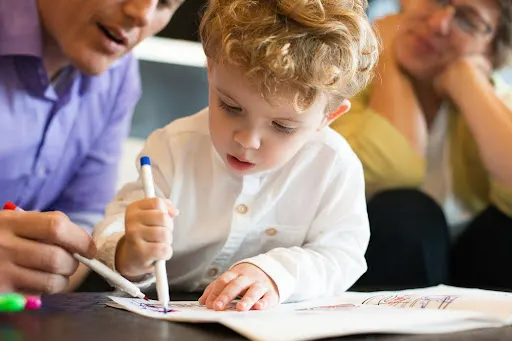
As our little ones come into the world, we watch them develop so many new skills in their first year of life. They smile, they pull up, they crawl, they speak. Did you know that many of these skills correlate to reading readiness a few years later? These milestones of early literacy development mark the journey that starts from infancy.
What Is Early Literacy Development?
Early literacy development refers to everything a child learns about reading, writing, and language before they can actually read or write on their own. It begins at birth — long before a child opens their first picture book independently — and continues through the preschool years. Far from being a single skill, early literacy is a cluster of overlapping foundations: oral language, vocabulary, sound awareness, print awareness, narrative understanding, and the social-emotional bond a child forms with books and the adults who share them.
Researchers and pediatricians agree that the first three years are an especially rich window. During this time, an infant’s brain builds the neural pathways that will later support decoding letters, understanding sentences, and reading for meaning. Every conversation, song, finger play, and shared book contributes to that wiring. Parents looking for a nurturing setting often search for the best infant daycare promoting early literacy and reading skills and the strongest programs are the ones that treat literacy not as a subject taught at a desk, but as something woven into every diaper change, mealtime, and lullaby.
In short, early literacy development is the everyday, joyful work of helping a baby fall in love with language. It does not require flashcards or formal lessons. It requires attention, repetition, warmth, and a steady supply of books, songs, and conversation.
Early literacy development is a process that begins in the first years of life. How do you engage an infant in activities that encourage early literacy? Best practices include many techniques that combine developmental milestones with “preparing” our youngest learners to become future readers. Simply engaging in everyday conversations, telling stories, and singing songs promotes language. Even games like “peek-a-boo” are always ways to incorporate early literacy activities for infants and toddlers into daily routines. Singing repetitive songs while changing diapers, buckling seat belts, and preparing dinner are easy ways to incorporate language and early learning with a simple daily routine. This everyday rhythm is exactly what a quality nursery program combining childcare with language and reading readiness provides — turning ordinary care moments into literacy-rich experiences.
How Does Daycare Help Babies Reach Early Literacy Milestones?
A high-quality daycare can be one of the most powerful environments for early literacy growth, because trained caregivers are intentionally building language and pre-reading skills throughout every interaction — not only during “story time.” Here is how a strong infant and toddler programme supports each milestone:
- Birth to 6 months — Listening and recognizing sound: Caregivers narrate diaper changes, name objects during feeding, and sing soft, repetitive songs so babies tune into the melody of language and the cadence of their primary languages.
- 6 to 12 months — Babbling and turn-taking: Teachers respond to babbles as if they are real conversation, teaching babies the give-and-take of dialogue that underlies all future reading comprehension.
- 12 to 18 months — First words and pointing: Educators label objects, narrate actions (“You’re rolling the ball!”), and read short, predictable board books to grow vocabulary.
- 18 to 24 months — Vocabulary explosion: Daily read-alouds, finger plays, and circle time songs help toddlers connect words to meaning at a rapid pace.
- 24 to 36 months — Storytelling and pretend play: Children begin to retell familiar stories in their own words, narrate their pretend play, and recognize a few letters or environmental print like their own name.
Because these milestones unfold in steady, predictable layers, a consistent daycare routine — with the same caregivers, same books, and same songs returning each week — is one of the most reliable ways to help every baby move forward at a healthy pace.
What Are the Benefits of Early Literacy Daycare?
Choosing a daycare that prioritizes early literacy is one of the highest-leverage decisions a family can make in the first three years. The benefits show up not only in reading scores years later, but in how a child speaks, listens, plays, and connects today.
- Stronger vocabulary and oral language: Children in language-rich settings hear thousands more words per day than those in quieter environments.
- Earlier phonological awareness: Daily exposure to rhymes, songs, and rhythmic play helps babies notice the sounds inside words long before formal reading begins.
- A genuine love of books: Repeated, cozy reading experiences turn books into a source of comfort, not a chore.
- Better listening and attention skills: Group story time, songs, and finger plays gently stretch a child’s ability to focus.
- Stronger social-emotional foundation: Sharing books and conversations builds the warm relationships that fuel learning.
- A smoother transition to preschool and kindergarten: Children arrive already familiar with print, pages, and the rhythm of being read to.
- Equity in early access: Quality daycare can close gaps for children whose home environments may have fewer books or quieter language exposure.
Supporting Phonological Awareness in Infants and Toddlers
At ages eight to sixteen months, older infants love to sing and dance. How does this help with early literacy? Singing and dancing are just a few of the activities that help our young learners develop a necessary phonological awareness, which helps ready them for reading.
There are many research-based ideas that link music with early literacy development. For example, when singing or listening to music, children need to retain patterns and rhythms in memory, which is also an integral reading-readiness skill. A daycare that supports phonological awareness in infants and toddlers builds these skills intentionally — through call-and-response chants, rhyming books, lap bounces, and predictable songs sung at the same time each day.
Phonological awareness — the ability to hear and play with the sounds inside spoken language — is one of the strongest predictors of later reading success. In infancy and toddlerhood, it is built through everyday rhythm rather than worksheets. Common ways quality programmes nurture it include singing nursery rhymes daily, clapping out syllables in children’s names, pausing inside a familiar book so the toddler can fill in the missing rhyme, and using instruments to drum out beats. None of this looks like “reading instruction” — and that is exactly the point.

Read on Top Benefits of Daycare for Infants and Toddlers
How Daycare Environments Help Children Develop a Love for Books
As our children grow and become toddlers at sixteen to twenty-four months of age, this early literacy development continues in various ways. As our infants become toddlers and begin to develop their fine motor skills and hand-eye coordination, they love to use instruments during musical play. As children clap, drum or shake to the beat, they learn to listen to, recognize, and attempt to imitate these same rhythms and patterns that are in their memory. Once again, this helps children develop phonological awareness, making meaning from sounds.
Toddlers are well known for their desire for independence and personal preferences as they develop a sense of self. They have their favorite books and often ask for those to be read over and over. The importance of this repetition cannot be understated, as both babies and toddlers thrive on routine and consistency. Keep those favorites by their beds, in your diaper bag or in the car. It’s an easy way to incorporate books into their day and a healthy distraction when babies get fussy. In an infant and toddler daycare encouraging love of books and reading, caregivers go a step further: they create cozy book corners at a child’s height, rotate beloved titles to keep favorites in play, model expressive reading with funny voices, and treat picture books as a doorway to conversation rather than a one-way performance. Over time, children stop asking “will you read to me?” and start saying “I want to read.”
Play-Based Learning and Literacy Development in Early Childhood Programs
Have you ever seen a toddler “hiding” in a box? Surprisingly, even this favorite activity of most toddlers has a connection to early literacy. Empty boxes encourage creativity and develop higher level thinking skills. While building with these boxes the children are learning about spatial relationships and problem solving, which are directly related to reading. After all, reading is a complex form of problem solving at its heart through decoding letters and making meaning. As a child narrates this exploratory play while playing in, out and with the box, language skills are advanced as well.
Play is not a break from literacy learning — for infants and toddlers, it is the main vehicle. Quality early childhood programmes design their environments and daily routines so that almost every kind of play strengthens some part of the literacy puzzle: sensory bins build vocabulary as children describe textures, dramatic play develops narrative thinking as toddlers “cook dinner” or “talk on the phone,” block play teaches sequencing and spatial language, and outdoor exploration sparks new words for what children see, hear, and feel. When caregivers join in and narrate the play — “You’re stacking the red one on top of the blue one!” — they double its literacy power without ever interrupting the fun.
Early Literacy vs Formal Reading Instruction
Parents sometimes worry that if their toddler is not being taught letters and sounds at age two, they are “falling behind.” In reality, early literacy and formal reading instruction are two different stages — and trying to skip from one to the other can do more harm than good. The comparison below shows where each belongs.
| Aspect | Early Literacy (Infants & Toddlers) | Formal Reading Instruction (Ages 5+) |
| Age Range | Birth to roughly age 4 | Typically begins in kindergarten or first grade |
| Primary Goal | Build oral language, sound awareness, and a love of books | Teach decoding, fluency, and reading comprehension |
| Method | Songs, conversation, shared reading, play, and routine | Phonics lessons, guided reading, structured writing |
| Role of the Adult | Warm conversation partner, reader, narrator, singer | Teacher delivering a sequenced curriculum |
| Pace | Set by the child’s developmental milestones | Set by the classroom curriculum and grade-level standards |
| Tools | Picture books, board books, songs, props, real objects | Decodable readers, workbooks, leveled texts |
| What Success Looks Like | Child asks to be read to, fills in rhymes, retells stories | Child reads connected text with growing accuracy and fluency |
The takeaway: a toddler does not need formal reading instruction. They need a language-rich, book-filled, playful environment so that when formal instruction does begin in kindergarten, the soil is already deeply prepared.
How Preschool Programs Partner with Families to Support Early Literacy
The strongest early literacy outcomes happen when the daycare and the family are working as a team. Children learn fastest when the songs they hear at school are also sung in the car, when a favorite classroom book also lives on the bookshelf at home, and when the questions a caregiver asks during story time mirror the ones a parent asks at bedtime. Good programmes treat parents as co-educators and make this partnership concrete in everyday ways.
- Daily communication: Teachers share what books and songs were enjoyed each day so families can echo them at home.
- Take-home book libraries: Programmes lend books each week so every family has fresh material to share.
- Family workshops: Sessions on how to read aloud, choose age-appropriate books, and support a bilingual home.
- Songs and rhyme sheets: Printed or recorded versions of classroom songs so parents can sing along.
- Cultural inclusion: Inviting families to share stories, songs, and books from their own heritage builds vocabulary and identity at once.
- Milestone conversations: Regular check-ins help parents recognize what their child is doing well and where extra support might help.
Music is another bridge between school and home. Daycare programs that use music for infant literacy development often send families a recording of the day’s songs so toddlers can sing along with familiar voices in the car or at bath time — turning every ride and routine into a literacy moment.
How to Choose a Daycare That Encourages Early Reading and Language Skills?
Not every daycare prioritizes early literacy in the same way, even when their marketing suggests they do. When touring programmes, use the checklist below to see whether literacy is genuinely embedded in the day or simply listed as a feature on the website.
- Watch for books at every height and in every room: Board books in the crib room, picture books in the toddler corner, books in the dramatic play kitchen — books should feel as normal as toys.
- Listen to the language: Caregivers should be narrating, asking open-ended questions, and singing throughout the day, not just at story time.
- Ask about read-aloud frequency: Best practice is multiple short read-alouds per day, one-on-one and in small groups, plus a daily group story time.
- Look for music and rhyme: Songs, finger plays, and lap bounces should be woven into transitions like diaper changes, mealtimes, and rest time.
- Inspect the environment for print: Children’s names on cubbies, labeled bins, and posted song lyrics help build print awareness naturally.
- Ask how teachers respond to babbling and early speech: Strong caregivers treat every sound as a conversation and expand on what the child says.
- Confirm low caregiver-to-infant ratios: Lower ratios mean more individualized language exposure for each child.
- Check for family communication tools: Daily updates, take-home books, and parent workshops indicate a programme that views literacy as a partnership.
- Ask about staff training: Educators should have ongoing training in early childhood development and language acquisition.
A simple test: visit at different times of day. The best programmes are language-rich at 9 a.m., at 11 a.m., during nap transitions, and at pickup — not only when story time is on the schedule.
To develop a child’s lifelong love of reading, children should be interacting with books early and often. The earlier that we can help children begin to associate books and reading with positive emotions, the better we are at fostering a love of reading and preparing them for reading success in the future. Contact us at 757-424-4327 to schedule a visit.